

UPC and European Unitary Patent
An international jurisdiction
The Unified Patent Court (UPC) is the first supranational court created in Europe to rule on disputes relating to unitary and “classic” European patents.
A new international jurisdiction common to the signatory States and complementary to the European patent system, with unitary effect.
Dedicated support
Lavoix:
Lavoix represents you before the UPC thanks to its multidisciplinary team of 44 representatives, including both intellectual property attorneys-at-law and qualified European patent attorneys
Structure of the UPC
The UPC consists of a court of first instance, a court of appeal, and a registry, together with an arbitration and mediation centre.
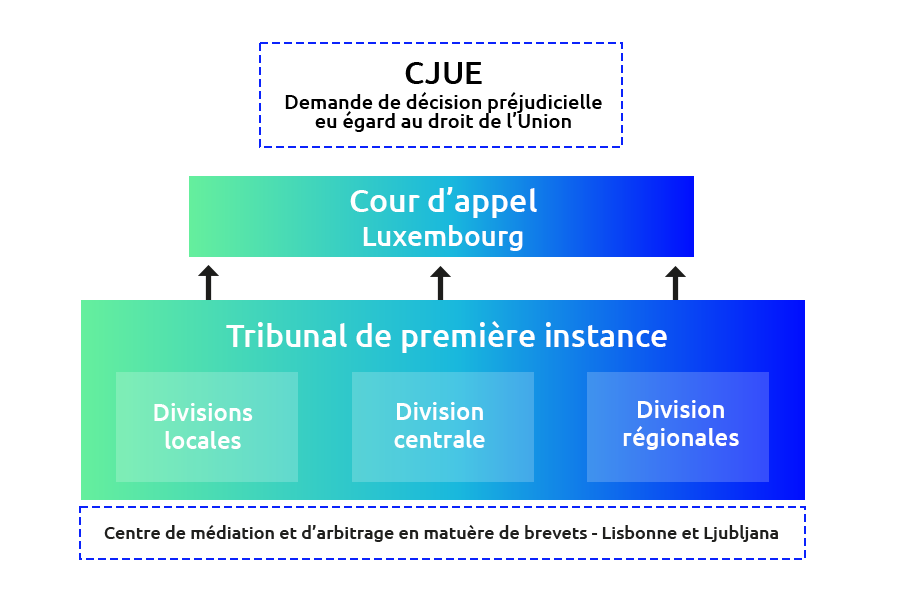
EPO Source
Opt-out
The UPC has exclusive and automatic jurisdiction over patent infringement and invalidity (stay-in).
However, during a transitional period of 7 years, which may be extended, holders of (non-unitary) European patents will be able to opt out from it, unless litigation before the UPC has already been initiated.
During this period:
easypatent
Lavoix offers you a free online simulation tool to compare your validation costs and annuities.
This simulation module, which all our clients can access from IP data², enables them to compare validation costs in real time, with or without a unitary effect, depending on the territorial scope chosen and the estimated maintenance period. It also includes options for customising scenarios and storing them in memory.
Transmission of your instructions is also available from easypatent.
FAQ
Effective from June 1, 2023, the Unified Patent Court (UPC) is an international specialized court with exclusive jurisdiction to handle disputes related to European patents (without opt-out) and unitary patents in the contracting EU member states.
Designed to harmonize patent protection across Europe and simplify the resolution of infringement disputes, the UPC represents a major step toward a unified innovation justice system.
Thanks to a single centralised procedure, the UPC now makes it possible to enforce or challenge a patent simultaneously in multiple European states, thereby enhancing the legal security and efficiency of the invention protection system.
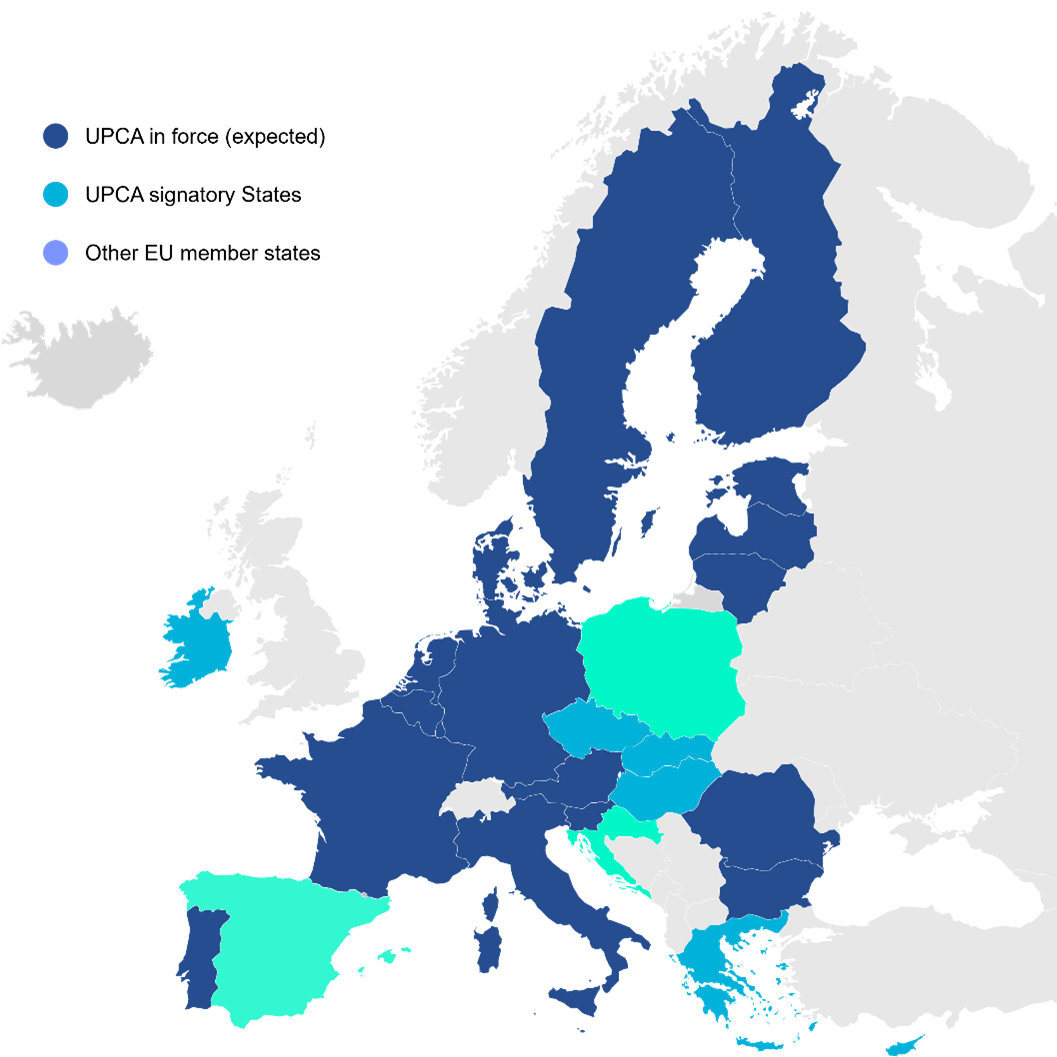
To date, 25 EU countries have signed the UPC Agreement (February 19, 2013), of which 18 have already ratified it. Its decisions only apply in the states that have ratified the Agreement.
The European patent with unitary effect, or unitary patent, is a European patent granted by the EPO that, upon request by the holder, provides uniform protection in the EU member states participating in the unitary patent system and that have ratified UPC Agreement (UPCA).
It applies only to granted patents and falls under the exclusive jurisdiction of the UPC. Any decision will be uniform across all participating states.
Note: The unitary patent does not apply to EPC member states outside the EU, nor to countries not participating in enhanced cooperation (such as Spain and Croatia).
The opt-out offers the possibility of withdrawing from the Unified Patent Court (UPC) jurisdiction during a transitional period of seven years, which may be extended once.
This option applies only to European patents without unitary effect, provided that an opt-out declaration is filed by the patent holder before any legal action is initiated before the UPC.
The opt-out can be requested at any time, up to one month before the end of the 7/14-year period, as long as no action has already been brought before the UPC.
Note: You may withdraw the opt-out at any time in order to pursue a potential infringer before the UPC (provided that no action has been initiated before a national court).
- Reduced costs: You won’t need to launch parallel procedures in different Member States (translations, taxes, etc.)
- Simplification of patent protection
- Expanded territory of protection
- Saves time
- Better resolution of patent disputes in Europe with the help of qualified, specialised judges
- European case law: Increased legal certainty for all users through uniform enforceability
To benefit from unitary effect, the holder of a European patent must submit a request to the EPO (European Patent Office) in the language of the patent grant, within a strict and non-extendable deadline of one month from the date of publication of the grant.
Just like a “classic” patent, the unitary patent provides protection for 20 years from the date of filing.
Note: It is possible to withdraw a request for unitary effect, provided that the withdrawal occurs before the EPO has issued its decision.
The Unified Patent Court (UPC) is composed of a Court of First Instance, a Court of Appeal, a Registry and a Centre for Mediation and Arbitration.
The Court of First Instance is structured into central, regional, and local divisions:
a) Central Divisions
- Paris (seat): Handles cases related to industrial techniques, transport, fixed constructions, physics, and electricity.
- Munich (1st section): Handles cases related to mechanics and weaponry.
- Milan (2nd section): Handles cases related to daily life necessities, chemistry, and metallurgy.
b) Regional Divisions
- Nordic Baltic Regional Division: Stockholm, Riga, Tallinn, Vilnius
- These divisions cover multiple countries and allow disputes to be handled within a specific geographic area.
c) Local Divisions
- Located in: Brussels, Copenhagen, Düsseldorf, Hamburg, Helsinki, The Hague, Lisbon, Ljubljana, Mannheim, Milan, Munich, Paris and Vienna.
- They provide access to the court close to the business or residence location of the parties involved.
The Court of Appeal, based in Luxembourg, is responsible for reviewing appeals against decisions made by the Court of First Instance. Its role is to ensure harmonization of decisions and legal consistency across Europe.
Also located in Luxembourg, the registry is responsible for administrative management, coordination between divisions, and monitoring procedures.
The Centre for Mediation and Arbitration is located in Lisbon (Portugal) and Ljubljana (Slovenia). As its name suggests, it offers alternative dispute resolution methods such as mediation and arbitration, aiming for fast and amicable settlements.
Our news
3
12, 2021
Yesterday, December 2nd, 2021, the Austrian Bundesrat (second chamber of the Austrian Parliament) approved unanimously the Protocol to the Agreement on a Unified Patent Court on provisional application (the PAP-Protocol) of the Unified Patent Court Agreement (UPCA).
14
10, 2021
The Unified Patent Court Agreement will enter into a provisional preparatory stage once 13 signatory states of the Agreement including Germany, France and the United Kingdom and having ratified said Agreement have ratified or expressed their consent to be bound by the Protocol on Provisional Application (A.3(1) of the Protocol).
16
08, 2021
The publication of the law in the Federal Law Gazette finally puts an end to the legal complications that have been blocking the german ratification process and, consequently, the establishment of the Unified Patent Court (UPC). But this does not mean that the UPC can finally start to operate.
12
07, 2021
By order of June 23, 2021, the German Federal Constitutional Court (FCC) rejected two applications for preliminary injunction against the Act of Approval that was adopted on December 18, 2020, for the purposes of ratifying the Agreement of 19 February 2013 on a Unified Patent Court (UPC Act of Approval). This decision was highly expected
(more)