

Publications, press articles, rankings, awards
The final rules for the European Patent Litigation Certificate are being adopted on 15th June 2022
Article 48 of the Agreement on the Unified Patent Court (UPCA) defines the obligation for parties to be represented before the Unified Patent Court (UPC).
EPO publishes second edition of the Unitary Patent Guide
Background
It is expected that the Agreement on a Unified Patent Court (UPCA) will enter into force end of 2022 or beginning of 2023. At the same time the European Union regulation 1257/2012 and 1260/2012 will enter into force relating to the European patent with unitary effect (Unitary Patent) and the translation arrangements.
The Select Committee of the Administrative Council of the European Patent Organisation has prepared the secondary legislation, in particular the Rules of procedure relating to Unitary Patent Protection and the Rules relating to the Fees for Unitary Patent Protection. Recently, some of the rules have been updated together with the Unitary Patent Guide.
Unitary Patent Guide
The Unitary Patent Guide explains in detail the procedure at the EPO for obtaining a Unitary Patent and the annex procedures.
In particular, it provides:
• General information about the Unitary Patent (Section A);
• Details how and when the request for unitary patent protection has to be filed and which information has to be provided to the EPO (Section B)
• The compensation scheme for specific SME and organisations (Section C);
• How and when the renewal fees have to be paid (Section D);
• The publication of the EPO regarding the Unitary patent, in particular the content of the register and a file inspection (Section E);
• Details how to register transfers, licences and other rights and file statements on licences of right (Section F);
• Other procedural questions like the language regime, representation and fee payment (Section G);
• Legal remedies against the EPO decisions, in particular the role of the Unified Patent Court and interlocutory revision by the EPO (Section H); and
• Transitional Measures.
The Unitary Patent Guide is regularly updated in its HTML version.
Record Filings at the European Patent Office in 2021
Despite the pandemic filings of European patent applications increased again. 188 600 patent applications were received by European Patent Office (EPO) in 2021, which is an increase of 4.5% in comparison to the previous year.
This is the highest number of applications ever filed in one year. The EPO’s Patent Index 2021 shows that patent filings rebounded significantly last year after a slight dip in 2020 (-0.6%).
In general the number of patent applications is seen as an early indicator of how the budgets of research and development investments of companies worldwide evolve. 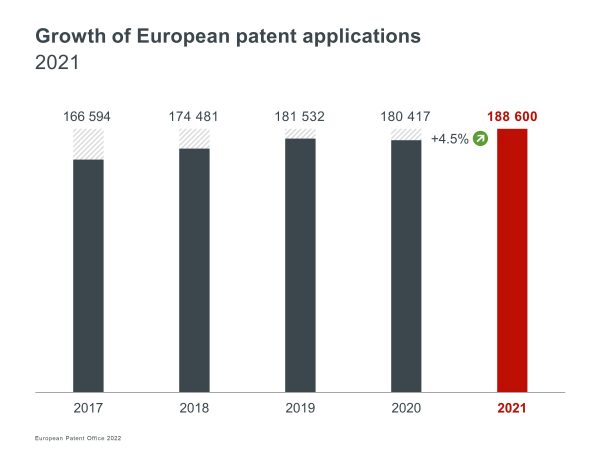
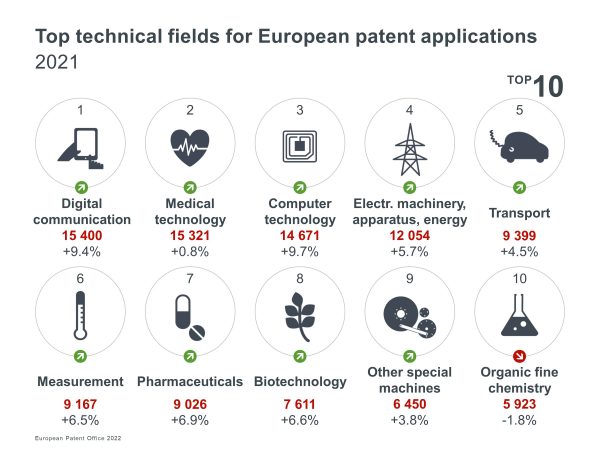
Source website of EPO
For applications in 2021 the top countries of origin were the US (25% of total filings), Germany (14%), Japan (11%), China (9%) and France (6%). Wherein patent applications are concentrated in a few countries, with five countries accounting for 64% of European patent applications in 2021, and the top 20 countries accounting for 95%.
The strongest growth in patent applications at the EPO in 2021 was happened due to filings from China (+24% in comparison to 2020) and the US (+5.2%). Applications from South Korea were also increased in 2021 (+3.4%), while Japan experienced a slight decrease filings (-1.2%). Patent applications from the 38 European Patent Organization countries experienced an slight increase last year (+2.8%). However, the number of applications from Europe continued to decline, falling from 50% of the total in 2013 to 44% in 2021. This trend shows that the European market is considered as relevant to companies outside Europe. Especially companies from Asia, seek to protect their inventions on the European market.
In accordance with the general numbers Huawei was the leading patent applicant at the EPO in 2021 (as in 2019), wherein Samsung, and LG were in second and third place. Ericsson and Siemens both moved up a position, to fourth and fifth respectively. The top ten includes four companies from Europe, two from South Korea, two from the US, and one from each of China and Japan.
This IP Alert is for information purposes only and does not constitute legal advice.
Record Filings at the European Patent Office in 2021
Despite the pandemic filings of European patent applications increased again. 188 600 patent applications were received by European Patent Office (EPO) in 2021, which is an increase of 4.5% in comparison to the previous year.
Which Nationality for a patent with unitary effect?
The patents’ nationality in case of joint ownership is determined by Article 7 of Regulation 1257/2012 which states: