

At the beginning of this year, it’s time for good resolutions.
Collecting and preserving evidence of use of your trademark is precisely a good practice, particularly if the registration of your trademark is approaching its fifth anniversary.
Indeed, except proper reasons, any trademark owner must be able to demonstrate a genuine use of its trademark for the covered goods and services for a continuous period of five years following its registration, failing which the trademark may be revoked (article 58, paragraph 1, a) of the Regulation of the European Parliament and of the Council, article L 714-5 of the French Intellectual Property Code.)
This obligation is binding, as it requires demonstrating a genuine use of the trademark for all the goods and services in the wording, or at least, for those contested by the opposing party during a revocation action.
If evidence of use relates only some of the goods and services, revocation will be ordered against the other goods and services for which the use of the trademark has not been demonstrated.
What happens when a trademark covers broad terms such as “cosmetics” in class 3 or “transport services” in class 39: is giving evidence of use for only some of goods or services within a broad category sufficient to maintain the trademark registration for that category in its entirety?
This question requires looking at the concept of “independent subcategories”.
The Court of Justice of the European Union stated that when a category is defined broadly and may be subdivided into independent subcategories, the trademark owner must demonstrate a genuine use of its trademark for each of those subcategories, failing which he will be liable to forfeit his rights to the trademark in respect of those independent subcategories, for which he has not adduced such proof (CJUE, October, 22, 2020, Ferrari C-720/18 and C-721/18).
The criterion of the purpose and intended use of the goods or services at issue is the essential criterion for defining an independent subcategory within a broad category.
Thus, as illustrated below, when broad categories may be divided into independent subcategories, evidence of use of a trademark for certain goods or services with a specific purpose or intended use, and therefore capable of being an independent subcategory, will only suffice to maintain the rights in respect of that subcategory, and not for the entire broader category!
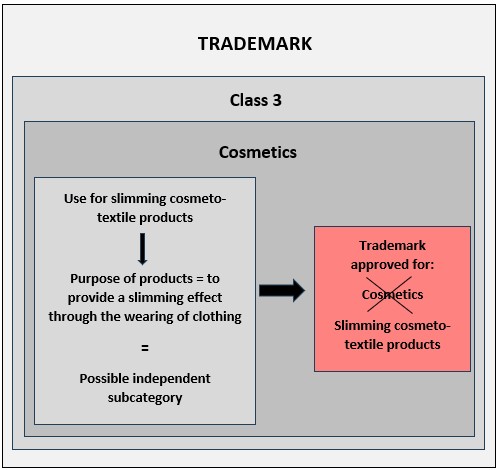
Therefore, when a broad category is involved, it is recommended to be careful and to gather evidence of use for each and every goods/services related to that category.
This subject gives rise to very casuistic legal decisions, the outcome of these decisions depending on the submitted evidence of use and the arguments raised by the parties to identify independent subcategories within a broader category.
In France, the Cassation Court notably issued two decisions on May 14, 2025, that can illustrate this notion:
1/ Decision No. 23-21.866, Univers Pharmacie SAS v. Skin’up SAS: the commercial chamber of the Cassation Court recalled the aforementioned principle and stated that the Court of Appeal should have examined whether the evidence of use submitted for cosmeto-textile products and their refills was sufficient to prevent revocation for the entire category of “cosmetics” covered by the trademark, or whether these products constituted an independent subcategory within the broader category of “cosmetics”.
2/ Decision No. 23-21.296, G7 Investissement SAS v. Groupe Rousselet : the commercial chamber of the Cassation Court stated that the Court of Appeal should have examined whether the evidence of use submitted for taxi services was sufficient to prevent revocation for the entire category of “transport” and “passenger transport services” covered by the trademark, or whether these services constituted an independent subcategory within the broader categories of “transport” and “passenger transport services”.
These decisions reflect the French Court’s intention not to confer a monopoly over a trademark that is only partially used and place on trademark owners the burden of proving use of their mark(s) in accordance with the goods and services as registered.
We remain at your disposal to:
- Draft wordings that reflect your actual or planned in the short/medium term activity, designation of broad categories no longer necessarily being a suitable strategy.
- Advise you on the relevant evidence of use to gather in order to safeguard your rights in the event of revocation proceedings.
- Assisting you during revocation proceedings to identify independent subcategories and then challenging the probative value of the evidence of use submitted by an opposing party.